
Pre-Master's Foundation Programme in Applied Mathematics (PMFP-AM) #2026 Structure
Campus
Dates
Part 1: Jun. - Aug. 2026
Part 2: Aug. - Sept. 2026
Part 3: Jan. - Mar. 2027
Delivery Mode
Online
ECTS Credits
30
Language
Part 1
Code: DT1303 | ECTS Credits: 3 | Delivery: Online | Taught hours: 18 | Language: English
Unit Coordinator: Mario Santilli
Content:
Linear spaces, linear dependence, bases of a linear space, dimension of a linear space, linear subspaces. Matrices, basic operations with matrices, change of coordinates, determinants, rank. A brief account on linear systems and Gauss elimination. Diagonalisation of squared matrices, eigenvalues, eigenvectors. Inner products, bilinear forms and quadratic forms.
Part 2
| ECTS Credits: 3 | Delivery: Online | Taught hours: 18 | Language: English
Unit Coordinator: Raffaele D'Ambrosio
Content:
Part 3
Code: DT1014 | ECTS Credits: 6 | Delivery: Online | Taught hours: 36 | Language: English
Unit Coordinator: Raffaele D'Ambrosio
Schedule of lectures, tutorials & exams
The Pre-Master's activities will be conducted on MS Teams, where class materials and recordings will be made available, as shown in the picture.
You can't access our dedicated channels on Microsoft Teams by yourself; you'll need to wait until you obtain an account (@student.univaq.it) via our office and then you'll be added to Teams by us. Please wait for our directions via email and do not try to register by yourself, thank you.
All activities of the first Part are 100% conducted online
Lectures are delivered asynchronously
That means that in the first half of June, the whole teaching materials and recordings will be provided on Microsoft Teams, and students will be allowed to learn at their own schedule.
The exam sessions will take place starting from mid-July
D.E.F.: July 21 at 2:30 CEST
I.L.A.: July 22 at 2:30 CEST
R.A.F.: August 19 at 2:30 CEST
II.L.A.: August 27 at 2:30 CEST
D.E.F.: August 31 at 2:30 CEST
R.A.F.: September 9 at 2.30 CEST
Basic Probability I - September 15, 2026 at 2.30 pm (booking)
Introduction to Numerics - September 16, 2026 at 2.30 pm (booking)
One retake for each test will be scheduled too
If you don't pass an exam, you will have the opportunity to attend tutoring classes delivered online in real-time (synchronously) in July-August.


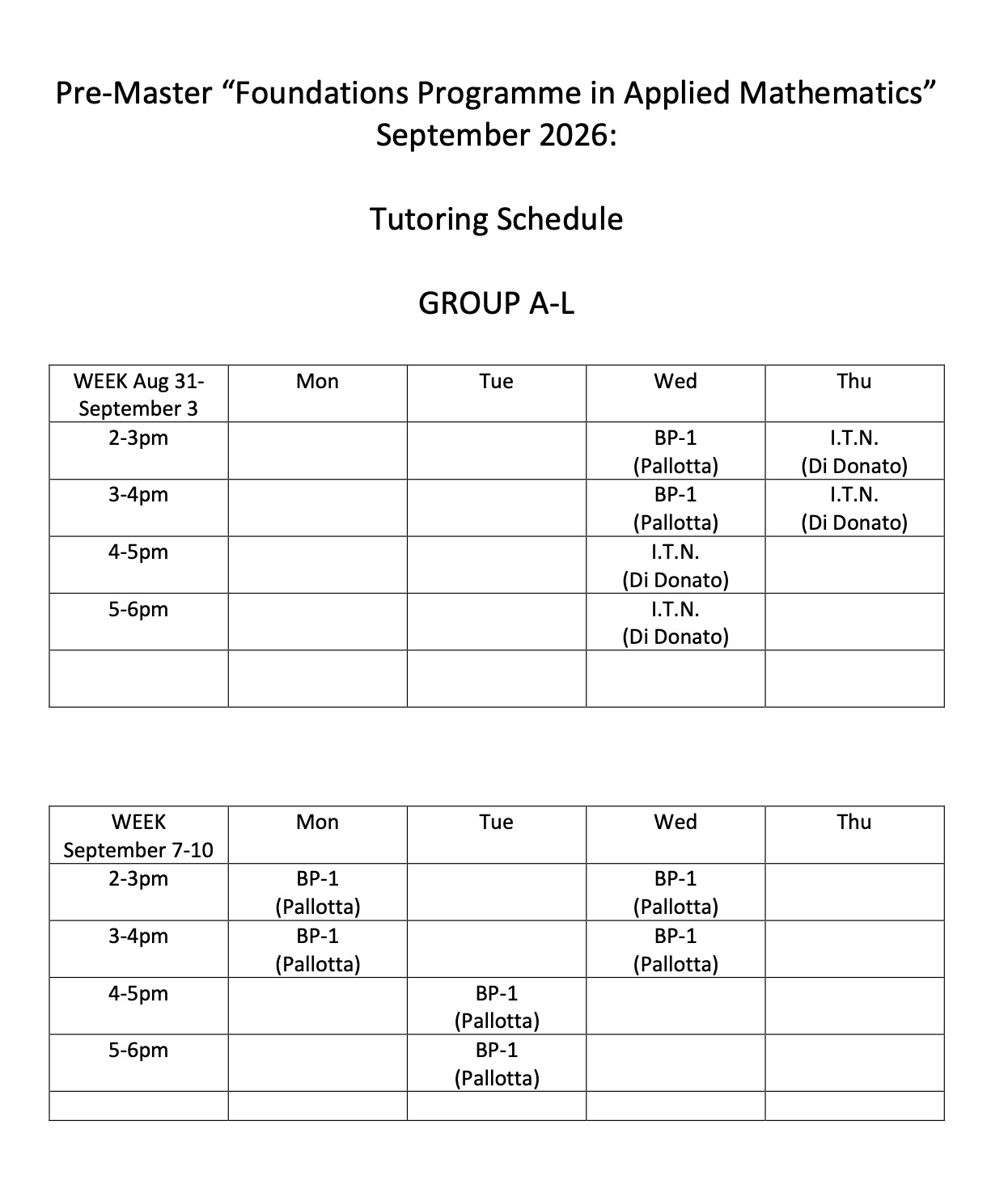
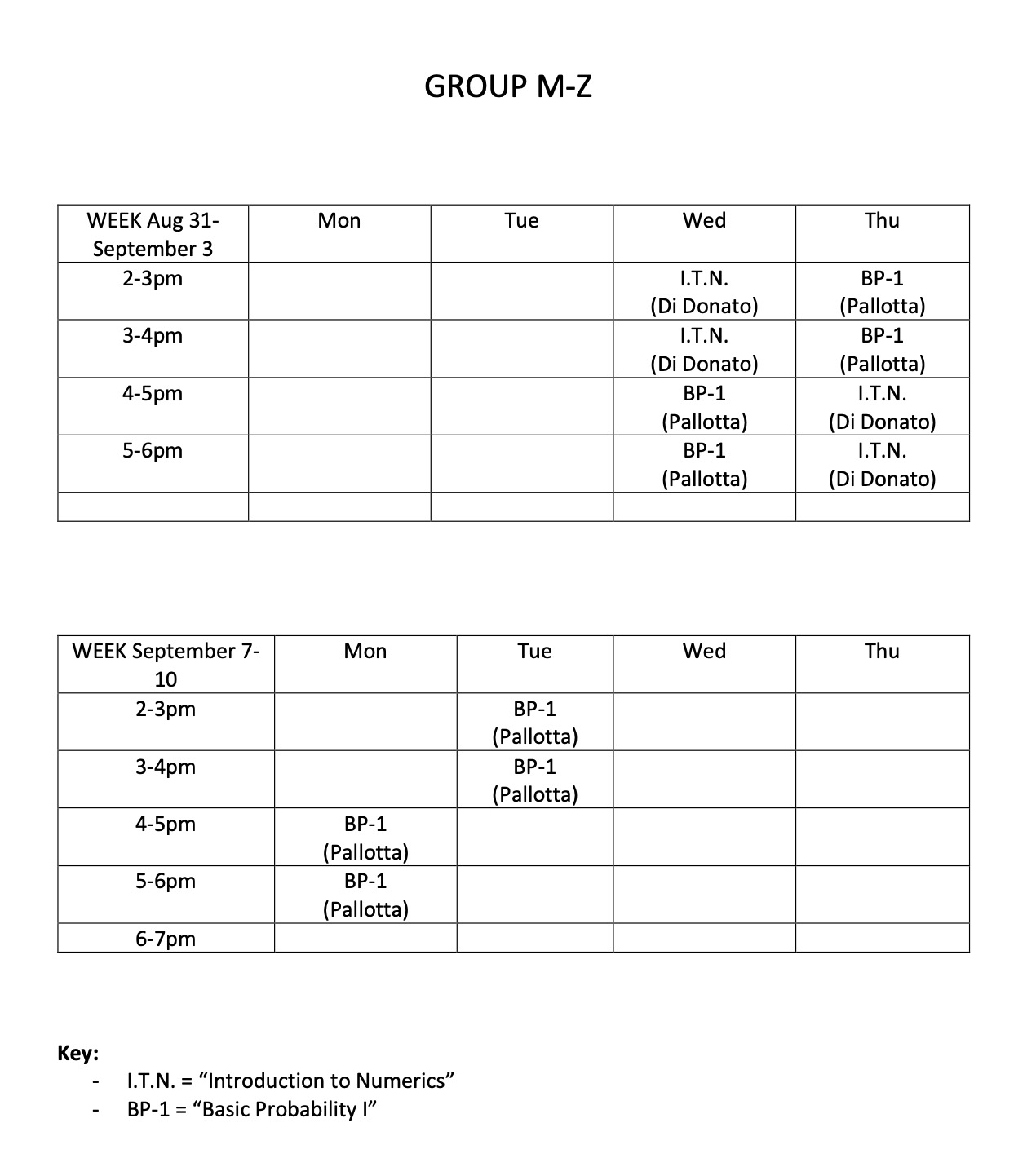
Overview: “Pre-Master’s Foundation Programme in Applied Mathematics”
Aims and Objectives
The Pre-Master's Foundation Programme (PMFP) in Applied Mathematics aims at homogenising the competency portfolio of prospective students of the two Master's Programmes in Mathematical Modelling and Mathematical Engineering at the University of L'Aquila, which includes the Erasmus Mundus programme "InterMaths - Interdisciplinary Mathematics", the joint Master's programme "MathMods", and the "InterMaths" Double Degree programme. Depending on the students' bachelor study programmes and on the education system in their country of origin, students enrolling in these three programmes may feature a very diverse set of skills in disciplines that characterise these Master's programmes. The PMFP in Applied Mathematics is designed to address this issue by covering specific competencies in both theoretical mathematics (Real Analysis and Linear Algebra) and computer programming. As for theoretical mathematics, the main goal of the PMFP is to bridge the gap between "calculus" and "real analysis", a typical issue arising quite often for prospective MSc students with a very "applied" background. The PMFM will include very basic topics of real analysis, enabling the students to deal with infinitesimal calculus with a rigorous "real analysis" perspective (including the use of rigorous mathematical proofs). On the other hand, students with a strong "theoretical" background sometimes lack basic programming and computational skills. Hence, the PMFP provides a basic introduction to computer programming and, in particular, to the computing environments "MATLAB" and "Python", which are widely used in the numerical analysis courses of the MSc programmes mentioned above.
Teaching delivery mode
All teaching activities are held in English. In order to ensure effective learning, the educational offer of the Pre-Master's foundation Programme includes taught classes with 6 hours for each ECTS, with at least 70% compulsory attendance, and may also include regular submission of assignments with deadlines, problem-solving sessions and intermediate tests.
In order to pass the exam for each course, students will have to pass at least two tests, to be fixed at least two weeks apart from each other.
Courses ending by the 16th of September 2025 will be held online. For the remaining courses, the instructor may opt for a blended mode, even making use of asynchronous teaching modes. The instructor may request the support of a tutor for accomplishing several integrative teaching activities.
Admission
Students enrolling in the MSc programmes
Mathematical Engineering
Mathematical Modelling
for the 2026/2027 cohort, who have obtained their Bachelor's abroad will, as a rule, attend this Pre-Master’s Foundation Programme. The Mathematical Engineering Council (CAD di Ingegneria Matematica) will appoint a committee to evaluate the academic documents submitted by each student who has expressed interest into enrolling the two MSc programmes by the 1st of July 2025, with the goal of detecting specific skills previously obtained by the student which overlap (partially or totally) the aims and objectives of the Pre-Master’s Foundation Programme. In the latter case, the aforementioned committee may admit the student to the PMFP with a personal plan having fewer ECTS than those provided by the standard study plan.
If deemed necessary, the committee may decide to complement the evaluation of the academic documents with an interview.