
International MSc Degree
RealMaths
Mathematics for Real World Applications
Duration
Pace
Language
Degree type
Double/Joint MSc
Campuses
Lyon (France); Hannover (Germany); L'Aquila (Italy); Gdansk, Katowice (Poland); Aveiro, Lisbon (Portugal); Karlstad (Sweden)
Latest News
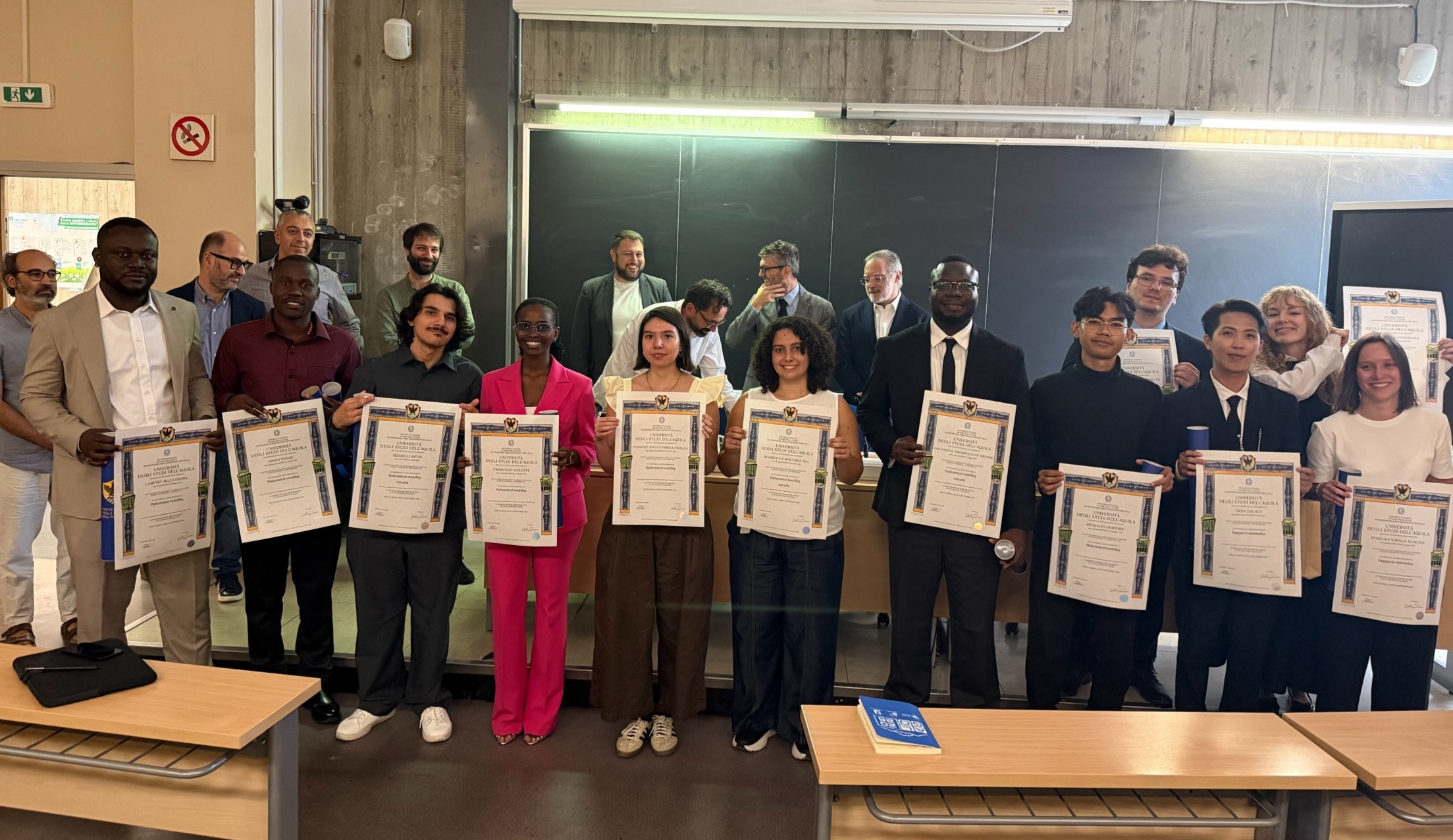
Graduation in L'Aquila Sept 18, 2026

Lecture Schedule: Semester 1 2026/2027


RealMaths – Mathematics for Real World Applications is a set of 2-year International MSc programmes with focus on scientific computing and applications. Students spend one year at the University of L’Aquila and one year in one of the partner institutions.
Our specialisations include modern applications in material science or socio-economical sciences, as well as innovative methodologies in high performance computing and data analysis.
Join RealMaths and gain a double/joint international MSc Degree in Applied Mathematics from two of our partner universities.
The programme starts every September and is structured into 2 academic years, each studied in a different country, as sketched below.
The current programme structure involves spending Year 1 in L'Aquila (Italy) and Year 2 in one of the other partner universities.
For the second year, our scientific committee will decide who goes where. The committee will do their best to reach a compromise between the choices made by each student in their application and the need for allocating a balanced number of students to each partner university.
Year 1
You will spend your first year at the University of L'Aquila, Italy
Study tracks for Year 2
Programme Details
Double MSc Degrees in Mathematics for Real World Applications Awarded by the InterMaths Consortium
In the second year of the RealMaths Internatinoal MSc Degree programme students will be working on their Master thesis, co-tutored by two researchers, one for each of the two institutions involved in their degree programme. Both thesis and defence will be conducted in English. The thesis defence will be conducted according to the teaching regulations of both the academic institutions involved.
Though candidates will receive a double/joint degree, they will have to defend their thesis only once. This will take place in front of a board of examiners including one professor/researcher, at least, for each of the two institutions awarding the master's degree. It will be run starting from June (and no later than September) of your Year 2, but the candidate will have to have completed all their exams first.
The RealMaths Programme is designed for completion in two academic years of full-time study and is taught in English. Upon successful completion of the Degree Programme,students are awarded two master of science degrees, one for each of the two Consortium Institutions involved in their curriculum.
Below you can find a list of the local Master's degrees awarded by the RealMaths consortium.
MSc Mathematical Engineering issued by the University of L’Aquila [sample]
MSc Mathematics and Applications issued by the University of Aveiro
MSc Mathematical Engineering issued by the Brno University of Technology
MSc Nanotechnology issued by the Gdansk University of Technology;
MSc Mathematics issued by the University of Karlstad
MSc Mathematics issued by the University of Silesia in Katowice
MSc Mathematics issued by Silesian University of Technology
MA Applied Mathematics issued by York University
Joint MSc Mathematics for Real World Applications issued by Leibniz University Hannover & University of L'Aquila
Language Policy
- IELTS Academic: overall band score of 6.0 or above;
- TOEFL iBT: overall score of 80 or above;
- PTE Academic: 56 or above overall;
- C1 Advanced (formerly known as Cambridge Advanced English): overall score of 169 or above;
- or equivalent to the above.
- a beginner's (A1) course in the Italian language during the first semester
- an elementary (A2) course in Italian language during the second semester.
Credit Transfer Policy
The InterMaths students are required to earn 120 ETCS credits (30 per semester, i.e. 60 per year) to graduate.
Student's performance is documented through the national grading system in force at each partner institution. The transfer and recognition of grades from one institution to another follows the European Credit Transfer and Accumulation System (ECTS) and is based on the Bologna Process and the European Higher Education Area.
Below you can view a chart showing the different grading scales in use at each partner institution and the corresponding grades (A, B, C...) and GPA.
Partner University | Partner Mark | UAQ Mark |
|---|---|---|
BUT (Brno University of Technology - Czechia) | A | 30 |
BUT (Brno University of Technology - Czechia) | B | 27 |
BUT (Brno University of Technology - Czechia) | C | 25 |
BUT (Brno University of Technology - Czechia) | D | 22 |
BUT (Brno University of Technology - Czechia) | E | 19 |
Gdańsk Tech, SUT, US (Poland) | 5 | 30 |
Gdańsk Tech, SUT, US (Poland) | 4.5 | 27 |
Gdańsk Tech, SUT, US (Poland) | 4.0 | 25 |
Gdańsk Tech, SUT, US (Poland) | 3.5 | 22 |
Gdańsk Tech, SUT, US (Poland) | 3.0 | 19 |
KAU (Karlstad University - Sweden) | VG | 30 |
KAU (Karlstad University - Sweden) | G | 24 |
KAU (Karlstad University - Sweden) | U | 15 |
UA (University of Aveiro - Portugal) | 20 | 31 |
UA (University of Aveiro - Portugal) | 19 | 30 |
UA (University of Aveiro - Portugal) | 18 | 29 |
UA (University of Aveiro - Portugal) | 17 | 28 |
UA (University of Aveiro - Portugal) | 16 | 27 |
UA (University of Aveiro - Portugal) | 15 | 25 |
UA (University of Aveiro - Portugal) | 14 | 24 |
UA (University of Aveiro - Portugal) | 13 | 23 |
UA (University of Aveiro - Portugal) | 12 | 21 |
UA (University of Aveiro - Portugal) | 11 | 20 |
UA (University of Aveiro - Portugal) | 10 | 18 |
Objectives
While applied mathematics has a longstanding history and tradition in classically related fields such as physics and engineering, it was only in recent years that research scientists started to rely on applied mathematicians to develop more refined and adequate models and techniques to be used in real-world applications. In actual fact, the past 20 years have seen an explosion of new mathematical tools used in biology, medicine, social sciences, material sciences, manufacturing, artificial intelligence, big data.
Higher education has started only recently to formulate such recent developments in the framework of well-structured study programmes encompassing both mathematics and real-world applications. This is partly due to academic research being still structured, to some extent, in separate compartments, with the likely consequence that a very useful “applied” mathematical result may have poor chancesto be published
in a renowned mathematical journal (unless it features truly innovative maths, no matter what the application is).
The International Double MSc Degree RealMaths aims at being a forerunner in this sense. We are an academic programme providing both advanced modern mathematics and a strong focus on real-world applications. The programme takes advantage of the very diverse skills and competencies shared by the “InterMaths Network” partners. Such a diversity defines the programme’s aims and objectives, in that it allows to provide complementary skills combining mathematics and other applied disciplines. To perform this task, the RealMaths Programme is structured into two years spent in two different universities in two different countries at least, in which the student is enrolled at the same time.
Our set of curricula covers a broad range of topics, mostly depending on the partners involved. After having gained an adequate and modern methodological preparation for the study and development of mathematical models in the first part of the programme, candidates will then have the opportunity to choose their second-year destination depending on the specialisation offered by the institutions involved.
Our graduates will possess the proper mindset of an applied mathematician combined with the capability to dialogue with experts from other sectors. Depending on the study path they will follow, students will be ready to undertake a PhD in Applied Mathematics as well as to start a career in businesses, industries, and governments.
Scholarships
Note that all the info below is still to be confirmed for the 2024 edition
Pre Master Bonus
We're proud to confirm that since the 2022 edition, all our students who attended our PreMaster Program have been awarded a special bonus worth 100 EUR for each ECTS credit gained (credits are awarded after successfully passing a course examination). That means that in the past editions, they obtained up to 1,500 EUR for the first part of the PreMaster Program (consisting of 15 ECTS credits).
Please note that all terms, conditions and amounts (which are usually disbursed before the Christmas break and might be subject to taxes) are yet to be defined for the 2026 edition.
Contribution to travel and installation costs from the University of L'Aquila
Sponsor. University of L'Aquila. Office in charge: International Relations Office
Details. By submitting your application before February 25, 2026 (1 pm Italy time), you will automatically be considered for a contribution to travel and installation costs provided by the University of L'Aquila worth around EUR 3,000.
Number of scholarships. The number of scholarships allocated to our programme has not been defined yet. However, consider that in 2025, around 25 scholarships have been allocated in total for the 3 programmes within our network.
How to apply? No additional application is required on your side. The University's overall ranking (which will involve all the other UAQ international students) will be based on our ranking. If selected, you will receive an award notification via email from the office in charge (international.students@univaq.it) typically in June-July. Contributions are expected to be paid by the end of December.
Erasmus+ Grant support for Students Mobility for Study (KA131)
Not to be confused with Erasmus Mundus (EMJM) scholarships!
In the paragraph below, when we use the word "mobility", we refer to a student enrolled at the University of L'Aquila who starts a mobility to study at our partner universities in Europe for a period. As you will be enrolled at the University of L'Aquila too for the whole duration of our programme, you're eligible to apply for mobility funding when you study abroad ("abroad" from the viewpoint of a L'Aquila student, then).
Sponsor. University of L'Aquila (Erasmus+ funding). Responsible Office: International Relations Office
Details. All our international students can benefit from Erasmus+ grants KA131 (Mobility for Study), provided by the EU via the University of L'Aquila, to finance up to 12 months spent on mobility abroad (for the RealMaths programme, it means the whole Year 2; for MathMods/InterMaths students, that means up to 6 months for Semester 2 and up to 6 more months for Semester 3 - but only if spent away from L'Aquila!).
Please consider that for your mobility, you might also benefit from an additional special fund (referred to as the Disadvantaged fund) addressed to students from families that have generated a low income in Italy.
All in all, such grants, i.e. Erasmus+ for Mobility (~300 EUR/month) and Disadvantage Fund (~250 EUR/month depending on your family income in Italy) are expected to award our students up to EUR 550 per month for 12 months at most.
How to apply? Applications for Semester2- mobility usually open in December, while those for Year2-mobility typically open in February. There will be a selection mostly based on your previous and current academic records. Anyway, note that so far the allocated funding has always been enough to cover all our students going on mobility, no matter the final ranking.
Lastly, bear in mind a general Erasmus+ rule: you cannot obtain any funding if you go on mobility in the same country as the one where you reside (e.g. a Spanish student cannot apply to the University of L'Aquila for funding to do a study mobility in Spain).
Other funding opportunities and benefits
2026-intake students may also obtain other funding opportunities and benefits even from our partner universities (some of our partner universities, for instance, have offered accommodation at reduced fares to our students in Year2). Detailed information about how to apply and what such funding may cover will be emailed to applicants later on.
To give an idea, you may find below details about the funding opportunities available to students of the 2023 cohort. In their Year1 & Year2 they have all been receiving from the Abruzzo Region Agency for Education (A.D.S.U.) - Abruzzo is the region where L'Aquila is located:
Up to 3,000 EUR per year as allowance
Up to 1,700 EUR per year as rent reimbursement
Up to 600 EUR max. per 10 months on mobility abroad (not awarded if you have already received from the University an amount that is greater than or equal to that).
Free meals at UAQ canteens as of January.
Note, such a grant is usually paid in 2 instalments: 1) a very small part (less than 1,000 EUR) by the end of December; 2) at some point in the following summer.
How to apply? The application usually opens in August. Scholarships are addressed to students from low-income families. A few more details will be provided via email by us. For more direct support, you may refer to our Alumni Association starting in August.
Grants by the Italian Ministry of Foreign Affairs and International Cooperation (MAECI)
The Italian Ministry of Foreign Affairs and International Cooperation (MAECI) offers grants to foreign citizens and Italian citizens living abroad to foster international cooperation in cultural, scientific and technological fields, to promote the Italian language and culture and to support Italy’s economic system in the world (According to Law 288/55 and its subsequent changes and additions).
Note that we don't offer any kind of support with this specific grant, but you may retrieve all the information required from the Ministry's official website.
Also, note that such type of grant might be incompatible with other grants you might be awarded for the same academic year (like the ones listed above by ADSU, Regional Agency). That doesn't mean that you cannot apply for the MAECI grant or for any of the others mentioned on this page. You're free to apply for any of them, but if you're selected, before accepting a specific grant, you'll have to check the related terms & conditions and ensure that they are not incompatible with any other grant you might have accepted in the meantime. If they are incompatible, you'll then have to forgo either before accepting.
Find out more about the MAECI grant
Chasing Science: the GSSI offers 16 scholarships for Master's students
The GSSI (Gran Sasso Science Institute), a PhD school based in L'Aquila, offers 16 scholarships to Master's students, worth €12,000 per year for two years, including the possibility of accommodation.
Note that we don't offer any support for this specific grant, but you can find all the required information on the GSSI call for applications 2026.
The deadline is April 30, 2026.
Find out more about the GSSI grant
Participation costs
EUR 3,000 per semester (i.e. 4 instalments for a total of EUR 12,000).
Our participation costs include registration in the RealMaths programme for both years, but do not include accommodation, living, travelling, or other personal expenses.
Note that participation costs include travel and health insurance for the 2026 edition.
Also, note that participation costs do not include the administrative costs due in some partner institutions, depending on the country: around 350 EUR per year in France; around 700 EUR per year in Germany; and around 1,000 EUR per year in Portugal. Luckily, countries like Italy, Portugal and Sweden do not currently apply any additional fee.
Partial fee waiver
The RealMaths Consortium will grant the 2026 cohort students a partial waiver of the participation costs. Based on that, the student will only have to pay the RealMaths Consortium:
- a total of 3,000 EUR, due in four instalments (750 EUR/semester) at the beginning of each term.
About the first semester, a 344-EUR non-refundable deposit will be required within 30 days after notification of selection, whereas the remaining amount is to be cleared before Semester 1 begins.
Finally, note that if the Consortium is not able to take out proper insurance for your Year 1 and/or Year 2 studies, the semester due amount will be reduced by 150 EUR.
Mobility
The RealMaths Double MSc programme will take place in two of the countries represented in the RealMaths consortium.
Our specialization tracks have been designed on grounds of the fields of expertise of the reference groups, often with links with groups in the same institutions from other applied disciplines.- All students will spend the first year at UAQ, Italy.
- For the second year, the cohort is split into groups in one of the parterns mentioned above.
Organization of student mobility
Students are assigned one of the Year-2 specialisation tracks. We shall try to distribute the students as uniformly as possible on the specialization tracks, taking into account their preferences.
In their application form students may specify their favourite tracks in preferential order and even select their non-preferable tracks. What we can guarantee at this stage, before the official mobilty paths are established, is that no student will be assigned to a track they have flagged as "non-preferable" in their application. That being said, the committee will do its best to reach a compromise between the choices made by each student on their application and the need for allocating a balanced number of students to each partner university.
Each student is provided with all the essential information about their mobility only after the actual beginning of the programme activities and in any case before the end of the first semester.
Student support
Support via email is available to our students and applicants throughout the year (responses are usually given in no more than 48 hours) in order to handle as many practical matters as possible, for example:
- applicants are assisted in pre-enrolement matters (how to apply, details on scholarships, documents required, queries about the study programme, etc.);
- selected students receive all the support they may need before actually joining our programme: invitation letters, visa, embassies, health insurance;
- enrolled students keep being assisted on many occasions, as when documents for various purposes need to be produced (registration certificates, transcripts of records...).
Direct support is offered by our teams, Alumni Association and international offices at each node to handle matters related to students' accommodation, arrival, health care and the like. Our dedicated Team and Alumni Association are made up of experienced welfare advisers, who can give help and advice on a variety of subjects, including general and personal matters. We also organise a couple of social events for international students, which include trips to the surrounding areas and dinners. Some examples of the support services available to our students are given below:
- general welfare issues;
- advice on academic policies and procedures;
- issues relating to our program, academic progress, failure or exclusion;
- information about the university and local community;
- welcome and orientation meetings;
- enrolment at university and related support (e.g. exam registration).
Student agreement
The RealMaths Programme is designed for completion in two academic years of full-time study.
At the beginning of their studies, students shall sign an agreement with the Consortium Coordinator, which contains important information about the obligations and responsibilities they assume when they are accepted to programme.
More specifically, the agreement regulates the duration of the whole Degree Programme; the structure of the joint study path, mobility, and study plan; attendance and responsibility for health and social insurance; circumstances that can lead to automatic exclusion from the Degree Programme, Consortium administrative fees and contribution to participation costs.
Student Section
Academic Calendar & Term dates
Key Dates | 2026/27 |
|---|---|
Semester 1 | 21 September - 8 January (PDF Schedule) |
Christmas vacation | 23 December - 6 January |
Semester 1 examinations | 11 January - 19 February (Exam Dates) |
Semester 2 | 22 February - 4 June (PDF Schedule) |
Easter vacation | 25 - 30 March |
Semester 2 examinations | 7 June - 23 July (Exam Dates) |
Italian Holidays | 1 November, 8 December, 6 April, 25 April, 1 May, 2 June, 10 June, 15 August |
UAQ Schedule of Lectures
Visa information
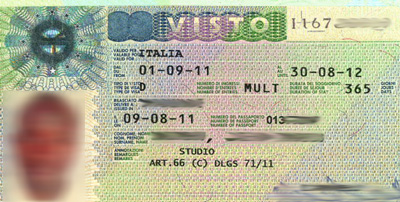
Applying for an Italian study visa
Non-EU students selected to study at the University of L'Aquila will need to apply for a student visa at the nearest Italian Embassy/Consulate. The visa application requirements and processing time can be lengthy, taking anywhere from a few weeks up to several months. It is very important that you contact the nearest Italian Embassy for information as early as possible.
Please notice that, before joining our programmes, you will only need to apply for one visa only at an Italian Embassy/Consulate, as Italy is the location for your first semester/year. Afterwards, while you're spending your semester(s) in Italy, you will have the chance to apply for another visa or residence permit, e.g. a German one if you're spending your Semester 2 in Hamburg, at the German Consulate based in Rome.

Web-based visa application on Universitaly.it
The visa application procedure is completely web-based. All non-EU students not living in Italy are requested to pre-enrol using the online platform called UNIVERSITALY. Once your pre-enrolment request on Universitaly.it has been approved by the University of L'Aquila, you will receive a confirmation email. After that, you will have to get in contact with the local Italian Diplomatic-consular mission for the visa request process. Please note that the university confirmation email does not automatically imply the issue of a study visa for you, which is all up to the Diplomatic mission you're in contact with, instead.
Documents required
Please get in contact with the local embassy/consulate to learn more about the specific requirements they might have in that region.
Recognition of Qualifications
To complete your visa application first and finalize your enrolment after reaching L'Aquila, you'll have to submit verification of your previous university qualifications
Residence Permit
If you need a visa to stay in Italy, remember that you will also have to apply for an Italian residence permit within 8 days of arriving in our country.
Italian Residence Permit
If you need a visa to stay in Italy, remember that you will also have to apply for an Italian residence permit within 8 business days after arriving in our country. A residence permit is indeed required when a foreigner stays in Italy for longer than three months.
The InterMaths team will assist you with preparing all the required documentation, which includes a couple of forms to be filled in and, among others:
A full copy of your passport (every single page, cover included)
A copy of your health insurance card
Accommodation proof
Financial proof
Enrolment certificate
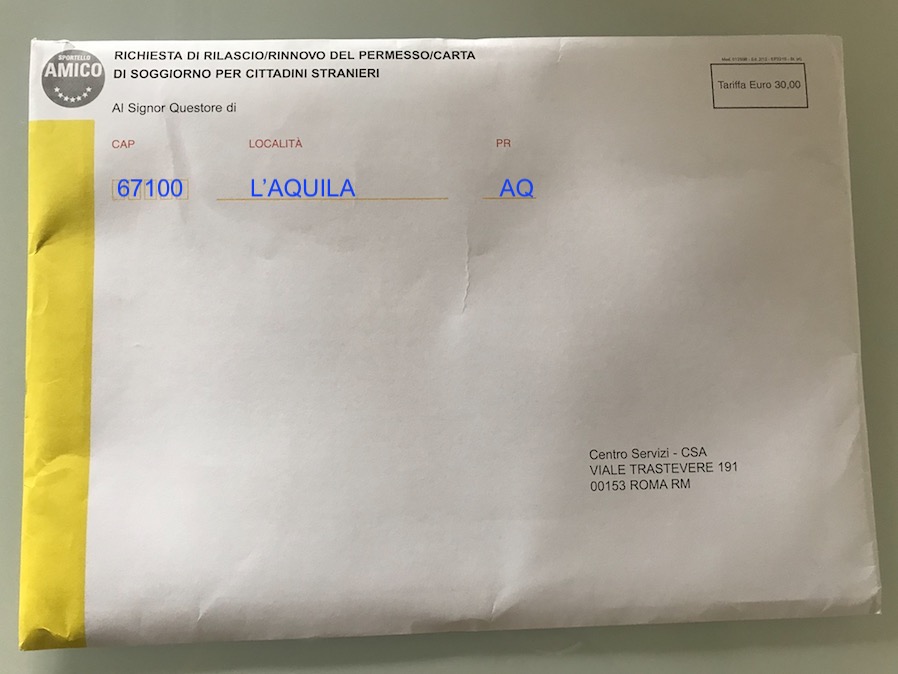
All you need to do is visit an Italian post office and withdraw the required form known as "kit permesso di soggiorno" ("soggiorno" sounds like "sojjorno"). Then, bring it to campus and we'll fill it in together!
After that, put all the required documents (including blank forms) back in the envelope, visit an Italian post office once again and complete the submission process (including payment of the required fees) with the post office clerks. After that, your application will be submitted to the L'Aquila Ufficio Immigrazione ("questura" in Italian, which sounds like "kuestura") via the post office itself.
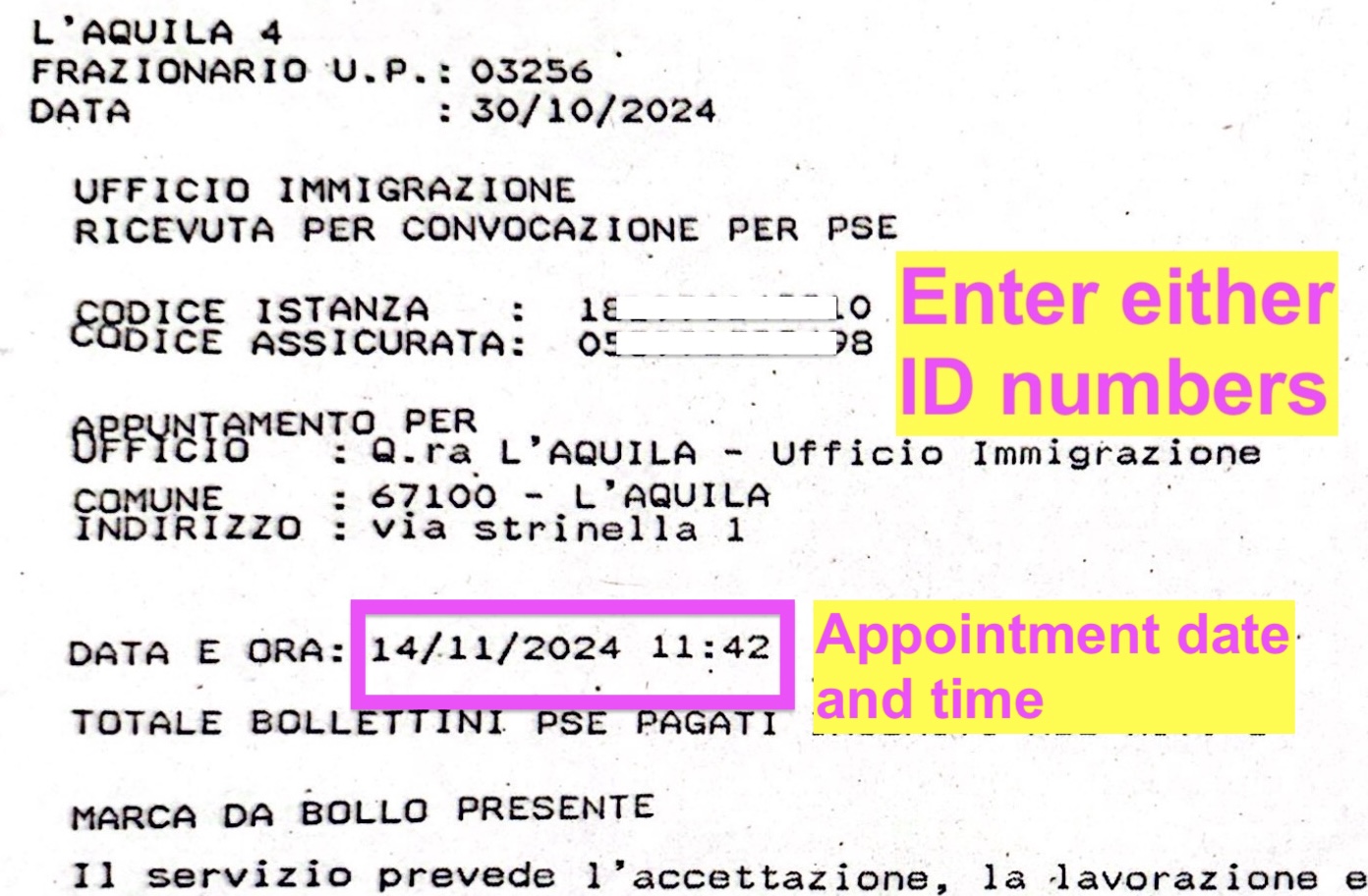
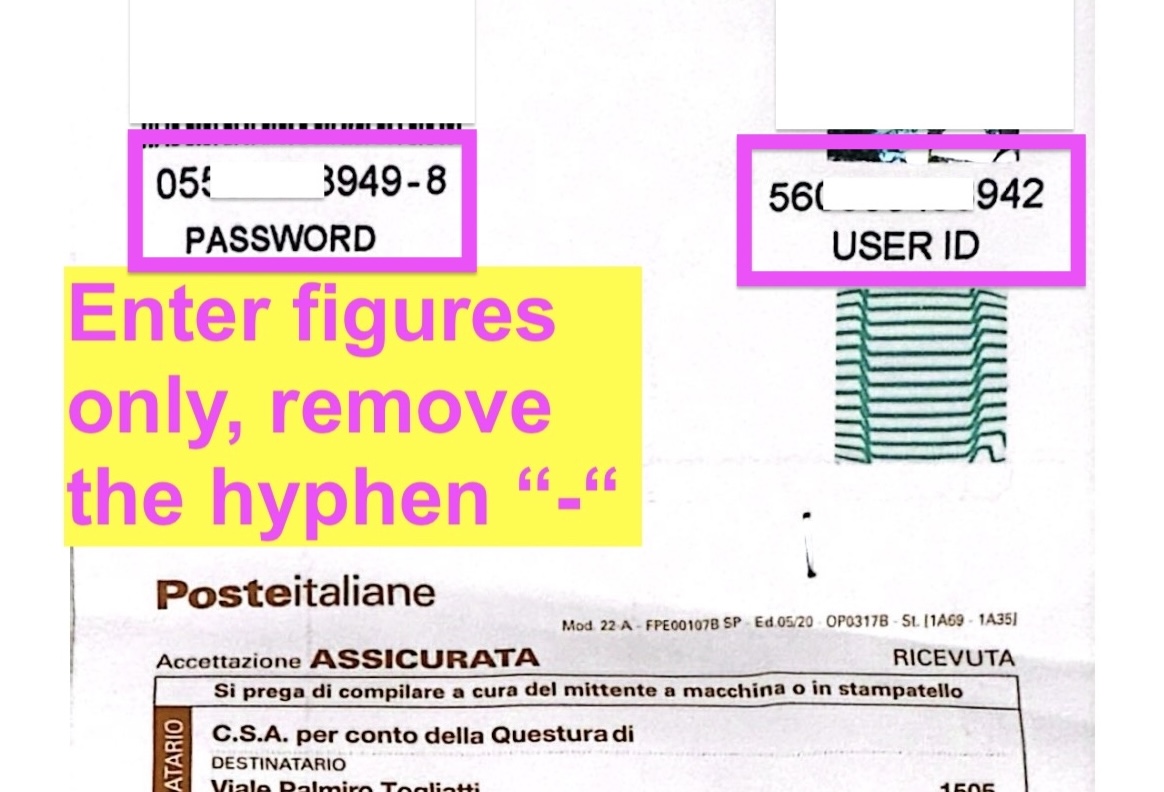
At the end of the submission process, the clerk at the post office will hand you three receipts, which will be considered as your temporary residence permit with a 9-month validity. Always carry a copy with you whenever you're around, and drop one off at our Registrar's Office to confirm your enrolment.
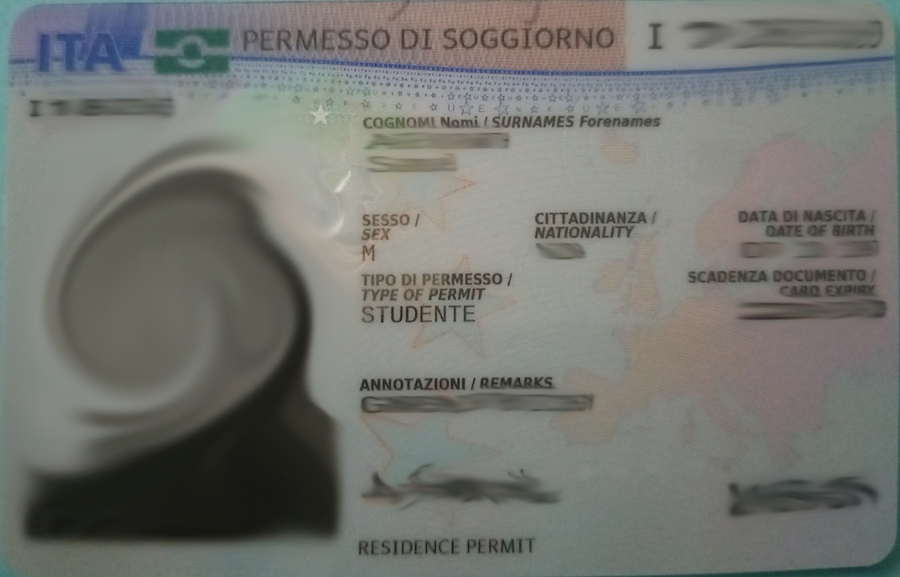
On such receipts, you'll also find the date and time of the appointment fixed for you at the L'Aquila Ufficio Immigrazione (Questura, Ufficio Immigrazione) to complete the rest of the required procedures, which include an interview for fingerprints (carry your passport & 4 ID-size photos). Eventually, you'll be summoned for another appointment to collect your final (plastic) permit card - the one you can see on this page.
The whole process will be complete in approximately 2 months (but it might even take longer) and will cost you around 120 euros.
Bear in mind that:
Your temporary permit has a 9-month validity and should only be used to study and travel in Italy.
You should NOT use your temporary permit to travel outside Italy, because it is not recognised as an official permit outside the Italian territory.
However, you may use it to travel to your home country (the one where the visa was issued) and back to Italy as long as there is no flyover through non-Italian airports.
For more information, refer to your embassy/consulate in Italy and to these decrees: 9 agosto 2006 & 11 marzo 2009

Enrolment procedure
After getting to L'Aquila, you'll have to complete your enrolment at the University of L'Aquila, which is the coordinating institution of your MSc programme.
The enrolment process involves a preliminary online phase to be performed on our university info system "Segreteria Virtuale", which is usually taken care of by the InterMaths consortium.
The process consists of:
Account registration
Online pre-enrolment (it has nothing to do with the Pre-Enrolment on Universitaly.it to get a study visa)
Fee payment.
Afterwards, to finalize your online enrolment, you'll have to submit:
Qualifications (i.e., transcript and degree certificate) from your university of origin in their original format.
Verification of your previous university qualifications. To do so, you'll have to submit ONE of the following certificates:
CIMEA comparability & verification certificates
CIMEA (ENIC/NARIC network) has implemented a service of certification and comparison of Italian and foreign qualifications.
Declaration of Value (DoV)
The DoV is a document providing an official description of your academic certificates, duly legalized by the Consular office of the Italian Embassy in the country where such a degree was gained.
Diploma Supplement
Direct Verification via UAQ
Starting this year (2024 edition) you may entitle the University of L'Aquila to contact the institution where you obtained your previous degree and verify the genuine nature of your qualifications. Further information about this procedure will be emailed to you by our staff.
Note that some local Diplomatic-consular missions might still require you to obtain a Declaration of Value (DoV) or a CIMEA statement before they issue your study visa, even though they know that our university accepts other types of verification (any of the 4 listed above).
If that is the case, you will have to go through the DoV/CIMEA request process, otherwise, you will never obtain any visa from that specific embassy. Please check in good time in advance the particular requirements in force at the Diplomatic-consular you're about to visit for your visa.
For further information on this topic, check out the related webpage on the UAQ site: www.univaq.it/international
Health & Travel Insurance
AON 24/7 emergency assistance
Dial: +31104488260
Contact form (non-emergency cases): link
Find the nearest open pharmacy in L'Aquila
Doctor-on-call (Guardia medica)
Where? "Casa della Comunità", floor -1 inside the "Delta 6" building (Google Maps).
Usually available Mon-Fri from 8 pm till 8 am, and from 10 am on Sat till 8 am on the following Mon.
Psychological support
Anti-violence Support
Phone and WhatsApp: +39 340 329 0530
All our students (either non-EU or EU) must hold valid insurance covering risks related to health, accidents, death, permanent invalidity, and civil responsibility (including travel assistance) while they are outside their home country.
An insurance card will also be necessary to apply for a residence permit.
↘ Erasmus Mundus (EMJM) InterMaths students (either scholarship holders or not)
Before their arrival, they will receive free of charge an insurance card covering risks related to health, accidents, death, permanent invalidity, and civil responsibility, as per the minimum requirements set out by EACEA
↘ Other students (enrolled in the RealMaths or MathMods programs).
Non-European students must ensure they hold valid insurance to obtain a visa, a residence permit, and enrolment at university. Requirements may vary a lot from country to country, even within the Schengen area. Generally speaking, such insurance must offer coverage of medical costs for a minimum of 30,000 EUR, as well as risks related to health, accidents, permanent invalidity, urgent health attention and/or emergency hospital treatment or even death, including possible repatriation for medical reasons.
EU students, on the other hand, won't need to purchase any additional private insurance if they don't think they need one, as long as they hold a valid European Health Insurance Card (EHIC).
Though you may get an Italian residence permit even by providing cheap insurance coverage, we encourage everybody to ensure that the insurance you are about to purchase is as comprehensive as possible.
Note that some of the options listed below, though officially valid throughout the Schengen area, may not be sufficient to obtain a visa/permit when you are going to spend a semester in another country, in Germany or Austria, for instance. Always double-check before completing your purchase for a whole year or more, and contact the related staff at our partners in advance, because in other countries than Italy, they might require that you purchase a more comprehensive one and/or even public health insurance to obtain a visa/permit and even to seek enrolment at their university.
All the below-listed companies offer insurance that complies with the minimum requirements to obtain an Italian study visa and residence permit. Though they are all officially valid within the Schengen area, they might not be enough to obtain a visa/residence/enrolment in other countries than Italy.
Protrip-World by DrWalter
Waitaly. This is the cheapest option (direct link) in Italy. However, note that it is not EACEA compliant (thus, not valid for Erasmus Mundus programs), but it is still valid to obtain a study visa and an Italian residence permit to attend other programmes, like RealMaths, for instance.
During your study period in Italy, you may also consider registering with the Italian National Health Service ("SSN" is the Italian acronym). That will entitle you to
Have your general practitioner (GP), aka family doctor, whom you may contact and visit free of charge when needed,
Gain access to all National Health Service (SSN) services in Italy, just like Italian citizens, e.g. hospitalisation in public hospitals, specialists' medical visits, blood tests, x-rays, medicines, etc, at a discounted price (a so-called "ticket" is usually applied for medicines, visits, depending on the case).
However, note that registration currently costs 700 EUR per calendar year (that means, if you pay in September on your arrival, it will expire on December 31, and you will have to register again on January 1 for the rest of the year, Dec. 31). That is why we usually recommend student purchase valid, comprehensive private insurance and opt for registration with the National Health System only if they need to visit doctors and specialists regularly (accidents or sudden illnesses can usually be handled by a good insurer).
Housing options in L'Aquila
Student's halls of residence
In Italy, students' halls of residence (including other student facilities such as cafeterias, gyms, etc.) are not managed by universities. The public body in charge of them is, in our case, the Abruzzo Regional Agency for Education, aka A.D.S.U. (Azienda per il Diritto agli Studi Universitari - L'Aquila), instead.
If you wish to find a place in the dorms and shared flats managed by A.D.S.U., you will have to apply typically in July. But note that:
Places are limited and usually reserved for students from low-income families.
Ranking lists might be published even in late October, which means you will be spending a lot on a temporary place to stay (e.g., a bed and breakfast) in your first weeks in L'Aquila while you are waiting for the lists to be out.
Applying for UAQ-ADSU housing - Deadline July 27, 2026, at 1 pm CEST
We are pleased to inform you that this year, the allocation of part of the places that ADSU offered in their residences last year will be directly managed by the University of L’Aquila.
The call for applications has recently been published and is available here.
UAQ-ADSU will offer accommodation in two student residences called:
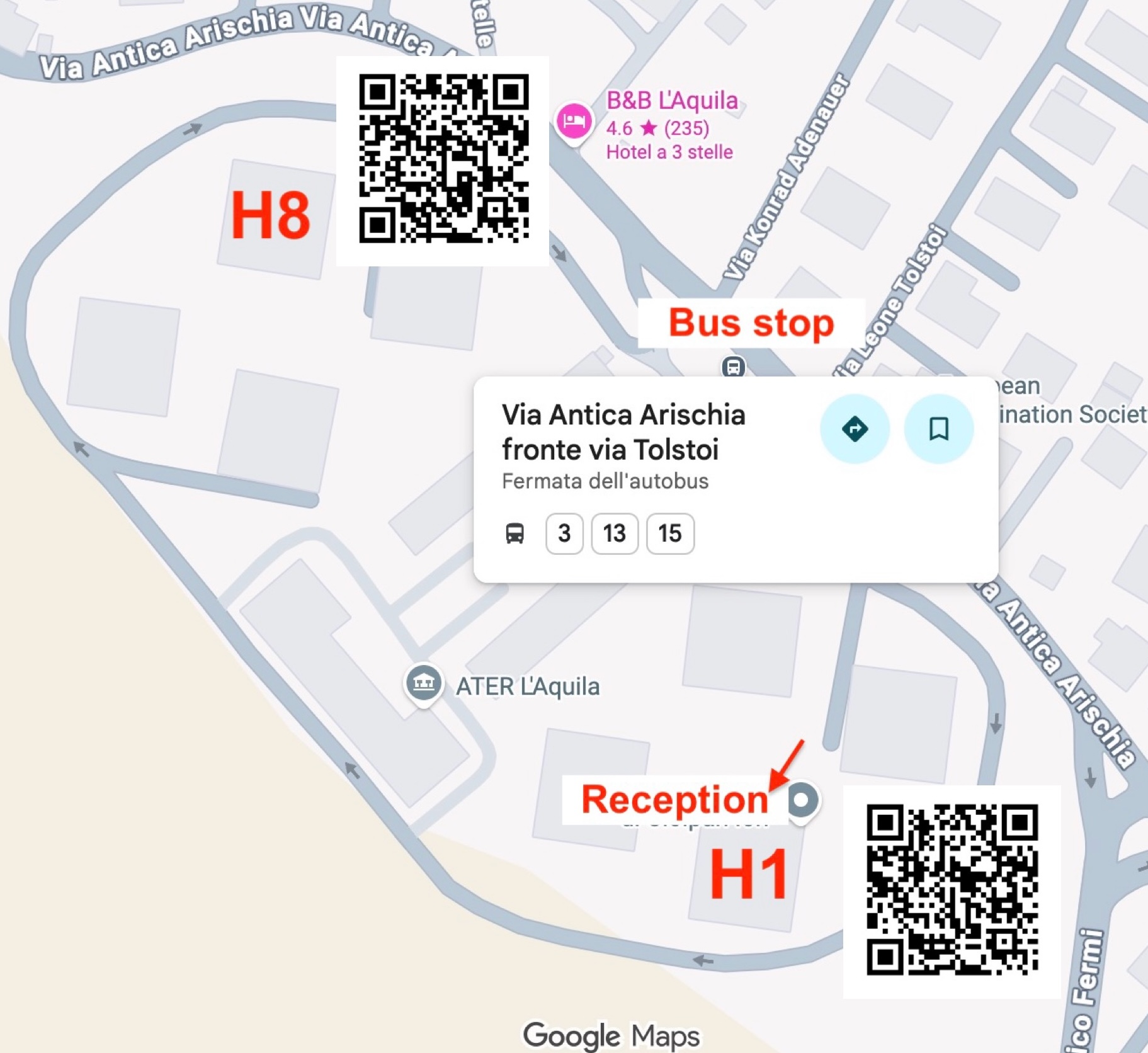
"Il Moro H1 and H8 blocks": 110 spots available in single and double rooms (with twin beds); located in Via Antica Arischia 46, a 15-minute walk from the DISIM campus in Coppito;
"Campus Cannelle": 50 spots available, mainly in double rooms with twin beds (a limited number of single rooms available here), situated in via Tancredi da Pentima 2, a 15-minute walk from the city centre.
For more details about terms, conditions, and fares, refer to the official announcement.
Private shared flats
As L'Aquila is undergoing huge reconstruction after the 2009 earthquake, we strongly suggest you opt for renting a flat from private owners. The cost per person ranges from 200 to 350 euros per month, depending on several factors, e.g. shared or private rooms, utility bills included or not, and neighbourhood. By the way, living near the campus (the area is in a suburb in west L'Aquila known as Coppito) can be cheaper, but this means living away from the city life (events, nightlife, restaurants...).
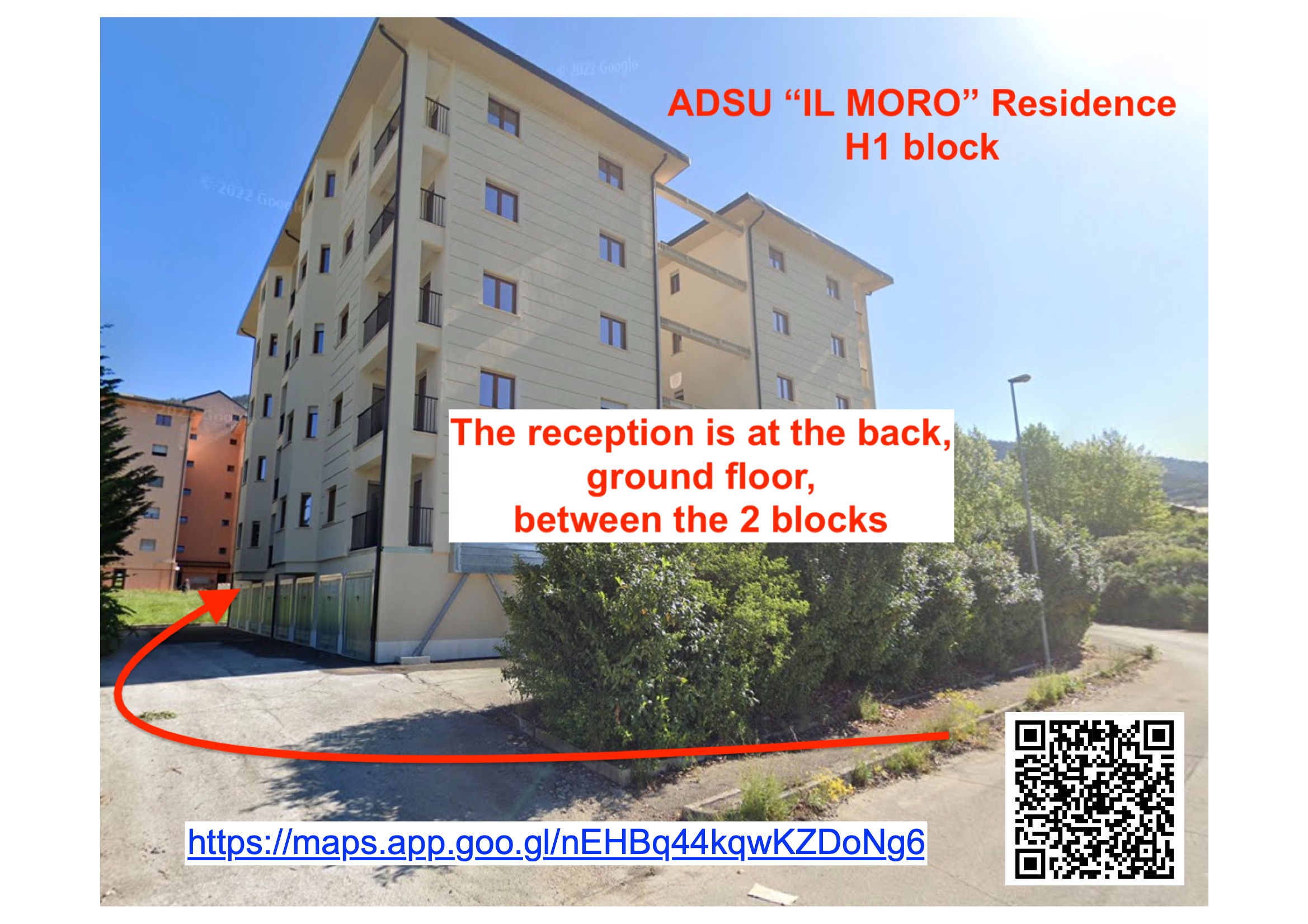

You may contact Aquilasmus - ESN L'Aquila to get support from a buddy in finding a place to stay in L'Aquila.
Housing options in L'Aquila
CAMPLUS
Camplus is a private residence located right in L'Aquila city centre. It includes single and double en-suites, maintenance, wifi, cleaning, utilities, etc. Check out the current selection announcement for more details and the application form.
ORLA
A newly opened private student's hall near the famous tourist attraction known as "99 cannelle", in the area of the train station.
ADSU Hall of Residence
ADSU (Abruzzo regional agency for education)
Adverts on Univaq.it
airbnb
Vacation rentals in L'Aquila
Idealista.it
Student House Est L'Aquila
In Paganica, east of L'Aquila (Google Maps)
FB group
"Cerco/Affitto Casa a L'Aquila!"
Bed & Breakfast in L'Aquila
Vacation rentals in L'Aquila
Periscopio
ADs listing on L'Aquila local newspaper
Collegio universitario Micarelli
Female students only
How to get to L'Aquila
Ideally located in central Italy, L'Aquila is approximately 100 km (~60 miles) east of Rome and 100 km (~60 miles) west of Pescara. Choose one of the following means of transport to find out more.
Rome Fiumicino
Rome Ciampino
Both airports are connected to L'Aquila by Gaspari or Flixbus long-distance buses departing right from inside the airport. Read the section below ("By Bus") for further information.
Additional bus services (operated by T.U.A. and Itabus) are available from the "Tiburtina bus station" (Stazione Tiburtina) located in East Rome. But that means you'll have to first get to the "Tiburtina train station" by train/bus, which will take you one additional hour or more.
Lastly, be informed that a couple of European cities are also connected to the Abruzzo Airport in Pescara, located about 100 km to the east of L'Aquila.
Getting to campus
Our programmes are coordinated and hosted by D.I.S.I.M. (Department of Information Engineering, Computer Science, and Mathematics) located on the Coppito campus in via Vetoio - West L'Aquila.
The Coppito campus also hosts other faculties: biology, chemistry, physics and, most importantly, the main city hospital ("ospedale" in Italian). Keep that in mind whenever you ask for directions, as everybody knows where the main hospital (ospedale) is.
Then, the University of L'Aquila is made up of several other campuses spread over the whole city, each of which has its own focus and identity. To get an overview, check out this interactive map.
Bus routes
Transfers with the airports in Rome and other cities in Abruzzo and the rest of Italy are operated by:
Transfers within the city of L'Aquila are operated by A.M.A. buses
There are two bus terminals:
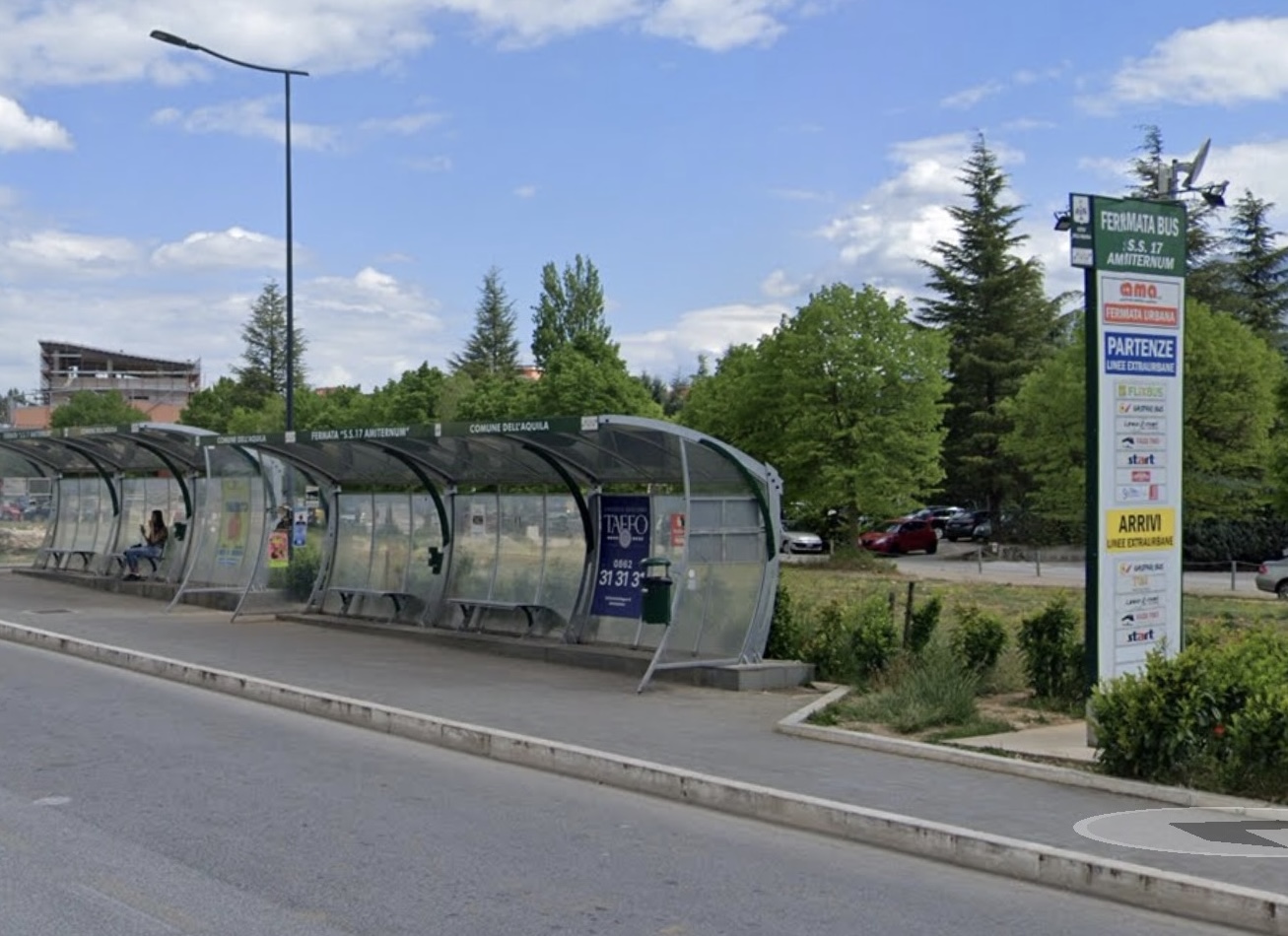
A small one in west L'Aquila (generally referred to as "Hotel Amiternum", "My Suite", "Motel Agip", "Strada Statale S.S. 17"), which is actually a stall, but it's the spot where most long-distance buses like Flixbus, Gaspari or others from Rome, Fiumicino airports and other nearby towns will stop (for both alighting and boarding).
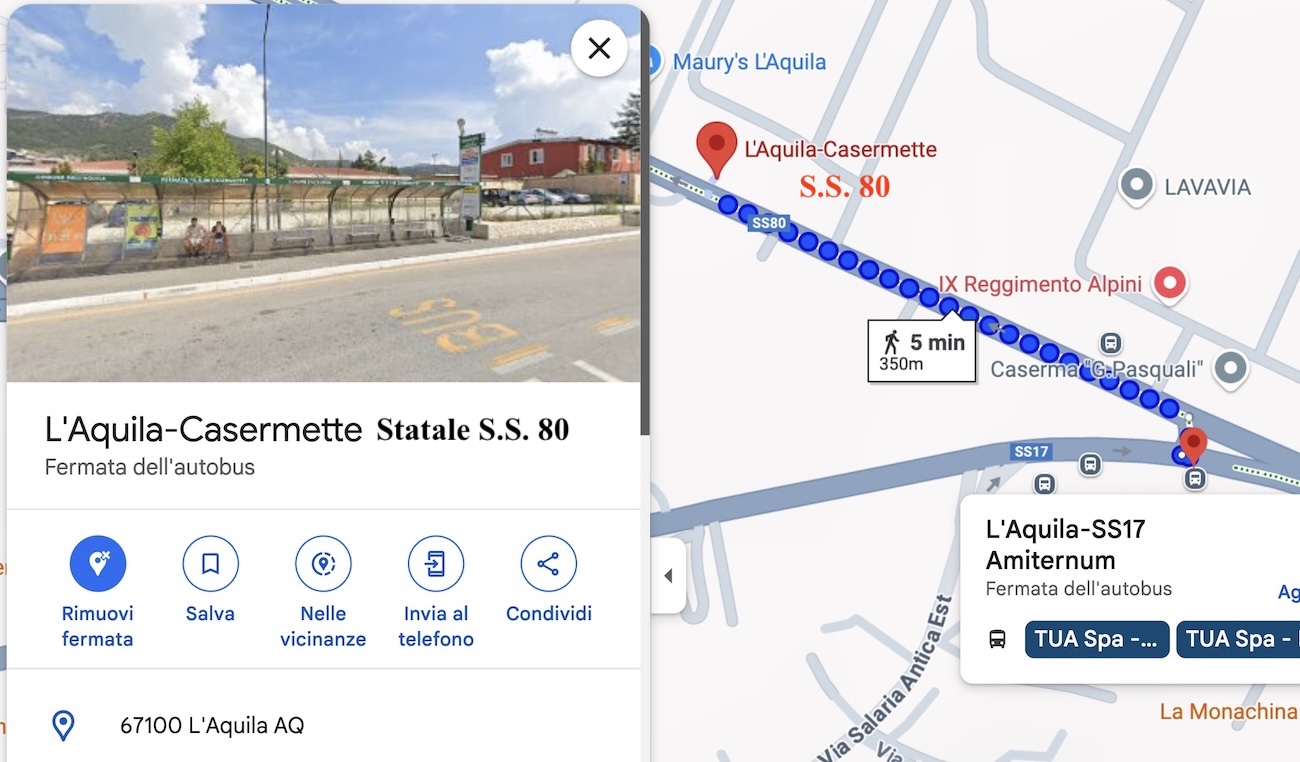
Be careful if you are going to catch a T.U.A. long-distance bus bound for Rome, because it will be departing from a different stall (referred to as "Casermette" or "S.S. 80") at around 300 m away. The same applies to local AMA buses bound for the Coppito campus.
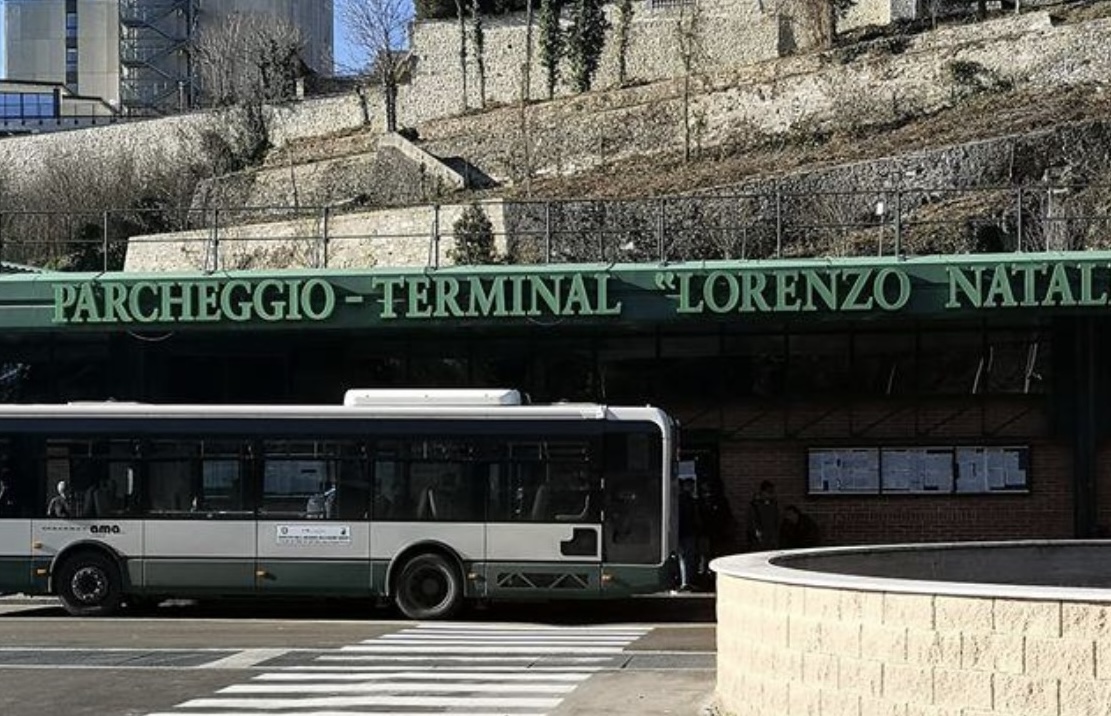
The actual Terminal in east L'Aquila (aka "Collemaggio" by locals because of the nearby Basilica, or more officially "Lorenzo Natali"), close to the historical centre.
A few notes on A.M.A. local buses.
Number 1 or 2U buses are very likely the AMA buses you'll need most, as they connect our campus to the bus station at the My Suites Hotel (aka Hotel Amiternum), the "L'Aquilone" shopping centre, as well as the main bus station (known as Collemaggio or Terminal) in the old city centre.
Most bus routes are now available on Google Maps. But you can still refer to the A.M.A. bus website, as shown below, and enter the word "ospedale" or "Università Coppito" in the search box (indirizzo di arrivo).

Travel Links
About L'Aquila
The City of L'Aquila in brief
- Reasonable cost of living
- A town of artistic interest
- Safe and quiet but also a lively university town
- Direct buses to Rome in little more than 1 hour
- Three popular ski resorts nearby as well as three national parks
- Sandy beaches at a short distance
L'Aquila is an Italian city with about 70,000 inhabitants and around 20,000 university students. It is the capital of the Abruzzo region and it is conveniently located 100 km (62 miles) east of Rome. The city is on a hill at 720 m (2365 ft) above sea level and is surrounded by mountains, most notably to the north by the Gran Sasso range, which includes the highest peaks (up to 2,900 m) of the Apennines, with several small lakes, trails and mountain climbing routes as well as deep caves. Within the province of L’Aquila there are also two national parks (Parco Nazionale Gran Sasso Monti della Laga and Parco Nazionale della Majella).
The city itself is full of history, traditions, beautiful buildings (like the Spanish Fortress) and churches (most notably, the Collemaggio Basilica). There are also a lot of good restaurants, pubs and places where students get together at night (most remarkably, on Thursdays and Saturdays). The city is also the home of L'Aquila Rugby - this team won the Italian championship five times.
For more practical and historical information about L'Aquila, click here.
Living costs
A student will spend approximately 600 euros a month:
Around 300 EUR on average for accommodation in a single room (in a twin room you may save ~50 EUR or more); note that such an amount does not usually include utilities (heating, electricity, water, Internet).
About 300 EUR to cover:
Meals (reduced fares for international students available for ~3 EUR or even free meals at the canteens in L'Aquila if you're awarded a Regional Grant).
Public transportation (a monthly bus pass in L'Aquila costs around 30 euros)
The costs for books, sports centres and other personal expenses.
University canteens and cafeterias are managed by ADSU. You will need to register with ADSU to get a digital canteen card. This will entitle you to reduced fares (~3 EUR) or even a free meal if you're awarded a Regional Grant by ADSU.
Canteen at the Math Department (Coppito campus)
Location: between the "Coppito 1 - Ricamo" and "Coppito 0 - Alan Turing" buildings, next to the University cafè.
Opening time: 12.30 pm - 3.00 pm Mon-Fri
Main university canteen (city centre)
Open for lunch (12.30~3 pm) and dinner (7.30~9.30 pm) even at weekends (Mon~Sun) in L'Aquila city centre: via Dell'Arcivescovado 8, right in the old city centre, next to the main square, Piazza Duomo
Café (Student's Bar) at the Math Department (Coppito Campus)
Opening time: 8 am ~ 6 pm Mon-Fri
Café at the Canada Centre (Coppito campus)
Opening time: 8 am ~8 pm Mon-Sat, 3 pm ~ 8 pm on Sunday
See here for more info: https://adsuaq.org/2025/12/04/orari-mense-adsu-laquila/

Free Time
Aquilasmus

Aquilasmus is an official student association, part of ESN (Erasmus Student Network). Aquilasmus offers several services to Erasmus students, like organising parties, trips, international dinners, cine forums and more. Take a look at their website, join their Facebook group and check out their Instagram page to get to know other international students and be involved in their activities.
Bars, restaurants, pubs & clubs, discos
Although several buildings in the old city are still to be reconstructed after the 2009 earthquake, dozens of bars and clubs have proudly reopened their doors. You will find lots of students hanging out mostly on Thursday nights (known as university night) and Saturday nights. Just ask the taxi/bus driver to drop you at "Fontana Luminosa" (the big fountain near the castle) and walk into the main road "Corso Federico II". You'll see that most people gather in a small square a few steps ahead, near "via Garibaldi".
Cinemas
-
Movieplex, Via Leonardo Da Vinci, Pettino, L'Aquila (25 mins walk from the Math Dept.)
Theatres
-
TSA Teatro Stabile dell'Aquila
-
Auditorium del Parco (near the Spanish fortress/castle)
Music
Excursions
Being L'Aquila ideally located in central Italy, you'll have lots of opportunities to visit Italy's top destinations: Rome, Naples, Pompei, Sicily, Florence, Venice, Verona, Milan, Turin, to mention just a few. The easiest and most convenient way to reach any of these destinations is from the bus/train stations in Rome, where you can get to by TUA/ARPA coach or Flixbus from L'Aquila (either from the bus station "Collemaggio" or from the Hotel Amiternum). Some destinations (Bologna, Venice, Verona to the North or the whole beautiful Apulia region in Southern Italy - most notably the Salento Peninsula) are more easily accessible from Pescara train station, where you can get to by TUA/ARPA coach from L'Aquila bus station or even by train (you'll have to change trains in Sulmona). Recently, most popular Italian cities have also been connected to L'Aquila by direct coaches (Flixbus).
And, if you're into art, don't miss out on the opportunity to visit Rome museums for free on the first Sunday of every month!
Short excursions around L'Aquila
Amiternum archeological site
 On the way to Pizzoli (west L'Aquila) you may stop by and visit the stunning archaeological site of Amiternum, an ancient Italic town founded by the Sabines and conquered by the Romans in the 3rd century B.C.!
The site features an amphitheatre, a theatre, public baths as well as an aqueduct.
For more information and opening times, visit this link.
Gran Sasso and other ski resorts
 Gran Sasso is Italy's second highest mountain (2,912 m asl). From the bus station in L'Aquila you can catch a number M6 bus (free shuttle buses at weekends!) bound for Assergi/Fonte Cerreto (1150 m above sea level), which is the base of the cableway that will take you to Campo Imperatore (around 2100 m asl). Campo Imperatore is a ski resort where you'll also find an astronomic observatory, a hotel (where Italian dictator Mussolini was held captive), an alpine garden, lakes and several breathtaking trails. The cableway may not be available all year round (it's usually closed in summer). Anyway, if it's closed, you may still decide to get to Fonte Cerreto to go on a hiking trip: there are several amazing hiking paths starting there!

If you are into skiing, there are another 2 popular ski resorts at a short distance from L'Aquila, with better facilities than Campo Imperatore:
- Campo Felice: see here
- Ovindoli: see here
Stiffe Caves (Grotte di Stiffe)
 Another place worth visiting in the neighbourhood is Stiffe (the nearby village is called San Demetrio dei Vestini), located at only 18 km from L'Aquila. The tour of these spectacular caves takes about one hour, but do not go there between November and April, as they may be closed because of the high water level inside. According to its official website, there are two buses going there every day from Collemaggio bus station in L'Aquila: one leaving at 8.15 am, the other one at 2 pm. Click here for details.
Calascio Fortress (Rocca Calascio)

https://en.wikipedia.org/wiki/Rocca_Calascio
How to get there: get to the bus station in Collemaggio (L'Aquila city centre), then catch a TUA bus to Calascio (check out the TUA website)
Lake Campotosto (Lago Campotosto)
 Located at about 1,300 m asl, this lake is part of the Gran Sasso e Monti della Laga National Park. It was created back in the 1940s to produce electric power. In winter the lake gets almost completely frozen, while in spring and summer, lots of people get there for canoeing, windsurfing, bird-watching, fishing (a permit is usually required) or just for picnicking. The road around the lake is ideal for walking or cycling. Several hiking paths connect Campotosto to nearby villages like Capitignano, Montereale and Amatrice. Click here for more information. The easiest way to get there is by catching an ARPA bus from Pizzoli to the village of Capitignano, then walk up to the lake, but it is going to be a 1-hour hike up to the lake and could be a bit strenuous for some. If you wish to get straight to the lake, you'll have to first get to the bus station in Collemaggio (L'Aquila city centre), then catch a TUA/ARPA bus to "Lago Campotosto".
Marmore Waterfalls (Cascata delle Marmore)
 Marmore waterfalls are a man-made waterfall created in ancient times by Romans. Its total height is 165 m (541 feet), making it the tallest man-made waterfall in the world. Its source is a portion of the waters of river Velino (the rest of the river flows into a hydroelectric power plant), after flowing through Piediluco Lake near the community of Marmore. It pours into the valley below formed by the river Nera. Its flow is turned on and off based on a specific schedule, to satisfy the needs of tourists and the power company alike. Tourists try to be there the moment the gates are opened to see the powerful rush of water.
How to get there: catch a train from L'Aquila to Terni (a town in the nearby region called Umbria), then board a special bus called "Marmore link" which will take you from the Terni train station to the waterfalls in 20 minutes.
Adapted from Wikipedia
Gran Sasso National Laboratory
 From the official web-site
The Gran Sasso National Laboratory is one of the four INFN laboratories. It is the largest underground laboratory in the world for experiments in particle physics, particle astrophysics and nuclear astrophysics. It is used as a worldwide facility by scientists, presently over 900 in number, from 29 different countries, working at about 15 experiments in their different phases. It is located between the towns of L'Aquila and Teramo, about 120 km from Rome. Go to www.lngs.infn.it for more details and guided tours.
Beaches on the Adriatic coast
 There are many amazing sandy beaches on the Adriatic coast at only 1 hour-ride from L'Aquila. The easiest one to get to is Giulianova. All you have to do is get to the bus station in L'Aquila and buy a ticket at the TUA/ARPA office on the -2 floor. Get off at Giulianova Stazione (train station) and walk to the beach, it's just a few steps away. Alternatively, you can catch a Gaspari bus to another well-renowned seaside resort: San Benedetto del Tronto.
Other popular places are Alba Adriatica, Pineto, Pescara and Vasto. Pescara is by the way Abruzzo's largest city, with lots of shops, clubs and great nightlife, too. Just get to the main train station (Pescara Centrale, 2 hours away from L'Aquila, change trains in Sulmona; or just get there by TUA/ARPA bus). Outside the train station, you'll find yourself in the city centre with lots to do and see on the promenade that will take you right to the beach!
Sporting facilities
CANADA' Fitness Club [link]
WHERE. Coppito, campus of the Math Dept., just 2 minutes walking distance from our teaching buildings. MAP
DETAILS. Access to the area with weights machines ("sala pesi") costs only 25 euros/month (the average fare in other gyms is 40 euros) - a free trial pass is usually available. You can join extra courses like pilates, yoga, zumba, fitbox, and body pump, as well as reserve the outdoor fields. Check timetables and fares from the url.
CUS - Centro Universitario Sportivo [link]
WHERE. Statale 17 Bis (aka "Centi Colella", on the way from L'Aquilone Shopping Centre towards the My Suites Hotel - around 20 minutes walking distance from our department, but mind the traffic! Or just get on an AMA bus no. 2 or 19 from our department)
DETAILS. Large university sports centre with several halls and rooms for most popular sports (fitness, spinning, judo, climbing etc.), including outdoor fields (football, volleyball, rugby, tennis, etc.). Reduced fees for university students.
Piscina Comunale L'Aquila [link]
WHERE. Viale Ovidio 3 - L'Aquila (city centre, close to the castle)
DETAILS. City pool offering reduced fees for university students.
Circolo Tennis L'Aquila [link]
WHERE. Viale Ovidio 1 - L'Aquila (city centre, close to the castle)
SKI Resorts
Campo Imperatore [link]
Campo Felice [link]
Ovindoli [link]
L'Aquila Rugby [link]
WHERE. Strada Statale 17 Ovest, Centi Colella, L'Aquila (opposite the main Post Office)
L'Aquila football (soccer) Team [link]
There are quite a few private gyms (and swimming pools too) across the city, just google "palestra l'aquila" or "piscina l'aquila"
Libraries
Library in Coppito
(biblioteca in Italian), ground floor, Coppito1 building, DISIM (Math Dept.)
Open: Mon-Thu: 8.30 am – 7 pm, Fri: 8.30 am - 2 pm
The first time you enter the library you will be asked to register. So, bring with you an ID document and your student card.
More details can be found here
Library in the Department of Humanities (downtown, old city centre, address: viale Nizza 14)
Opening hours:
Mon - Fri: 8.30 am - midnight!
Sat: 9 am - 5 pm
Sun: 3 pm - 8 pm
Study & Computer rooms
You can find study rooms in the Canadà centre, which is at 2 minutes' walk from the main teaching building (aka Coppito1), (Math Dept).
There you'll also find a bar, a gym and a computer room, too.
Click here to view a map
Click here for their Facebook page
AON 24/7 emergency assistance
Dial: +31104488260
Contact form (non-emergency cases): link
Out-of-hours (on-call) doctor
Where? "Casa della Comunità", floor -1 inside the "Delta 6" building (Google Maps).
Usually available Mon-Fri from 8 pm till 8 am, and from 10 am on Sat till 8 am on the following Mon.
Find the nearest open pharmacy in L'Aquila
Psychological support
How to get to L'Aquila
Ideally located in central Italy, L'Aquila is approximately 100 km (~60 miles) east of Rome and 100 km (~60 miles) west of Pescara. Choose one of the following means of transport to find out more.
Rome Fiumicino
Rome Ciampino
Both airports are connected to L'Aquila by Gaspari or Flixbus long-distance buses departing right from inside the airport. Read the section below ("By Bus") for further information.
Additional bus services (operated by T.U.A. and Itabus) are available from the "Tiburtina bus station" (Stazione Tiburtina) located in East Rome. But that means you'll have to first get to the "Tiburtina train station" by train/bus, which will take you one additional hour or more.
Lastly, be informed that a couple of European cities are also connected to the Abruzzo Airport in Pescara, located about 100 km to the east of L'Aquila.
Getting to campus
Our programmes are coordinated and hosted by D.I.S.I.M. (Department of Information Engineering, Computer Science, and Mathematics) located on the Coppito campus in via Vetoio - West L'Aquila.
The Coppito campus also hosts other faculties: biology, chemistry, physics and, most importantly, the main city hospital ("ospedale" in Italian). Keep that in mind whenever you ask for directions, as everybody knows where the main hospital (ospedale) is.
Then, the University of L'Aquila is made up of several other campuses spread over the whole city, each of which has its own focus and identity. To get an overview, check out this interactive map.
Bus routes
Transfers with the airports in Rome and other cities in Abruzzo and the rest of Italy are operated by:
Transfers within the city of L'Aquila are operated by A.M.A. buses
There are two bus terminals:
A small one in west L'Aquila (generally referred to as "Hotel Amiternum", "My Suite", "Motel Agip", "Strada Statale S.S. 17"), which is actually a stall, but it's the spot where most long-distance buses like Flixbus, Gaspari or others from Rome, Fiumicino airports and other nearby towns will stop (for both alighting and boarding).
Be careful if you are going to catch a T.U.A. long-distance bus bound for Rome, because it will be departing from a different stall (referred to as "Casermette" or "S.S. 80") at around 300 m away. The same applies to local AMA buses bound for the Coppito campus.
The actual Terminal in east L'Aquila (aka "Collemaggio" by locals because of the nearby Basilica, or more officially "Lorenzo Natali"), close to the historical centre.
A few notes on A.M.A. local buses.
Number 1 or 2U buses are very likely the AMA buses you'll need most, as they connect our campus to the bus station at the My Suites Hotel (aka Hotel Amiternum), the "L'Aquilone" shopping centre, as well as the main bus station (known as Collemaggio or Terminal) in the old city centre.
Most bus routes are now available on Google Maps. But you can still refer to the A.M.A. bus website, as shown below, and enter the word "ospedale" or "Università Coppito" in the search box (indirizzo di arrivo).